
The Book of Hebrews vs The Roman Catholic Church
Did you know that the Roman Catholic Church only has an official stance on somewhere between five to ten sections of Scripture? And much of what they do have is found in the Council of Trent (1545–1563) and was a direct result of the influence of the Reformation. With that in mind, let’s take a little detour from the writings of the Roman Catholic Church and instead do a careful examination of Jesus as we read through much of the book of Hebrews below.
Although the author of Hebrews was somewhat focusing on Jewish believers, trying to help them wade through the many religious waters called Judaism, we can also see a very direct parallel to Roman Catholicism.
Did you know that the general layout of Roman Catholic churches has been intentionally designed to model the Jewish Temple? Here are a few brief examples:
- The cleansing laver at the entrance of the Jewish temple
The “holy” water placed at the entrance of the Roman Catholic Church (RCC) - The Jewish layout of the Outer Court, the Holy Place, and the Holy of Holies
The RCC layout of Narthex, Nave, and Sanctuary - The Jewish temple was oriented toward the east
In a RCC, the priest and the congregation typically faces east during the liturgy. This is called “as orientum”. - The Jewish temple contained the Ark of the Covenant.
Each RCC has an altar where the “sacrifice of the mass” is performed and a tabernacle where the eucharist is kept. - The Jewish temple had a thick veil separating the Holy Place and the Holy of Holies.
The RCC often has icons or other walls or barriers to establish a separation.
A Few Considerations When Reading the Book of Hebrews
The focus of Hebrews is on the truth about Jesus and His full, free, and finished work on the cross. This should become quite evident after reading through the verses below.
Hebrews draws a very distinct line between following religion and following Jesus Christ and His Word.
The author of Hebrews builds an excellent case for how someone is truly forgiven for his/her sins and can walk in the power of the Holy Spirit.
Another Reminder
There are terms in Hebrews that won’t mean the same as some have been taught, especially those in the Roman Catholic Church. Keep in mind the Roman Catholic Church wasn’t even close to be an entity when Hebrews was inspired and penned and yet it speaks most about Jesus and His perfect and sufficient sacrifice for all mankind for all time.
The concepts, phrases, and terms that might sound Roman Catholic only do so if you inject your post-Hebrews, post-Bible, Catholic-induced meanings into God’s Word.
When words, phrases, and concepts like “partake” and “the body of Jesus” are used in Hebrews, we must be extremely careful not to import outside ideas into the text. Too often, we willingly accept someone’s unbiblical or extrabiblical teachings when we haven’t taken enough time with the Lord in His Word.
External teachings can easily and often unwittingly be received by hears if told early enough, long enough, and convincingly enough.
For us to grow in our biblical understanding, we must be very cautious not to allow outside influences to inject unbiblical concepts into our understanding. Words like grace and sacrifice must be defined by God’s Word, yet all too often, people learn definitions outside of God’s Word and then have no other option than to superimpose them onto the text. This is not how we should be reading God’s Word if we’re truly interested in growing in our Godly understanding.
A Couple More Things…
Let us think carefully of the purpose of the Old Testament and the law. The Bible is clear that no one can be saved except by being perfect. This, of course, is impossible. We’ve all sinned and fallen short of the glory of God (Romans 3:23). The law is good because it has a good purpose. The law was a shadow, pointing to Jesus, pointing forward to the only One who could and would fulfill the law. Keeping all the laws for salvation is not the goal.
If we have laws today that brought salvation, then what was the shadow in the Old Testament actually pointing to? More laws? It’s more that fair to conclude that since God gave Israel His laws and all mankind a moral compass called the conscience, then all of what God has provided should naturally point back to Him. If we instead follow man-made, religious rules and rituals, then those rules will inevitably lead us back to ourselves.
For sake of staying focused on God’s Word, we will not attempt to dive into each of the unbiblical decrees and rules in the Catholic Catechism. However, we will point out at the end several paragraphs worth highlighting. Please do not skip this section. For example, did you know that according to the Roman Catholic Church, Muslims may be going to Heaven? Also, did you know that man can become gods? Both are in the official Catechism of the Catholic Church. References are provided below.
What’s Missing?
Often, we can tell a lot from what’s missing in a story. In Hebrews, there are a lot of things missing when considering today’s religious institution known as the Roman Catholic Church. As we go through the book of Hebrews, notice there’s no mention of earthly hierarchy, the need for certain procedures, rituals, or sacraments for salvation. There’s no mention of New Testament priests to perform blood or bloodless sacrifices, no physical temple, no magistrates, or no popes. There is no talk of Mary as our mediator… No talk of giving money for getting dead souls out of hell or the Roman Catholic purgatory… No talk of purgatory to take away sins…. No talk of any physical elements needed to add to Jesus’ sufficient sacrifice.
The silence in these areas is deafening!
The remainder of this article will attempt to go through each chapter of Hebrews, homing in on verses that specifically speak against many of the generally taught tenants and doctrines of the Roman Catholic Church.
Notes: There will be little in the way of commentary in hopes of encouraging readers to prayerfully and humbly consider what God’s Word is truly saying. Any personal commentaries or questions will be indicated with *. Verse references will be indicated with a number above that section of Scripture. All the verses below are in the King James version.
———————————————————————————————————–
The Book of Hebrews
Chapter 1
1-3
“God, who at sundry times and in divers manners spake in time past unto the fathers by the prophets, hath in these last days spoken unto us by his Son, whom he hath appointed heir of all things, by whom also he made the worlds; Who being the brightness of his glory, and the express image of his person, and upholding all things by the word of his power, when he had by himself purged our sins, sat down on the right hand of the Majesty on high…”
*God spoke to the Jews through prophets and then through the Final Prophet and Savior, Jesus Christ.
*Never does it say that we need to listen to priests as God’s mouthpieces today. Jesus is both our High Priest and The Prophet.
3
“[Jesus] being the brightness of his glory, and the express image of his person, and upholding all things by the word of his power, when he had by himself purged our sins, sat down on the right hand of the Majesty on high.”
*Jesus is the express image of God. Could a physical wafer ever equal the exact image of God?
5
“For unto which of the angels said he at any time, Thou art my Son, this day have I begotten thee? And again, I will be to him a Father, and he shall be to me a Son?”
*The focus is on God, the Father and the Son. Not “the mother”. There is no mention of the mother, the pope, or the church. Jesus is exclusively the Savior of mankind.
6
“And again, when he bringeth in the first begotten into the world, he saith, And let all the angels of God worship him.”
*Worship belongs to Jesus alone.
8
“But unto the Son he saith, Thy throne, O God, is forever and ever: a scepter of righteousness is the scepter of thy kingdom.”
*Jesus is God.
10
“And, Thou, Lord, in the beginning hast laid the foundation of the earth; and the heavens are the works of thine hands…”
*Jesus is our Creator and Lord.
14
“Are they not all ministering spirits, sent forth to minister for them who shall be heirs of salvation?”
*Our inheritance comes from Jesus, not any church institution.
Chapter 2
Note: Don’t worship angels. (Warning from God in both chapters 1 and 2)
3
“How shall we escape, if we neglect so great salvation; which at the first began to be spoken by the Lord, and was confirmed unto us by them that heard him…”
*Jesus is Lord! Salvation is through Jesus alone!
7
“Thou madest him a little lower than the angels; thou crownedst him with glory and honor, and didst set him over the works of thy hands…”
*Mankind is lower than the angels. This includes Mary, Peter, every pope, and all those who serve in the magisterium.
8
“Thou hast put all things in subjection under his feet. For in that he put all in subjection under him, he left nothing that is not put under him. But now we see not yet all things put under him.”
*Everything is subject to Jesus, not any church or man.
9
“But we see Jesus, who was made a little lower than the angels for the suffering of death, crowned with glory and honor; that he by the grace of God should taste death for every man.”
*It’s imperative we keep our focus on Jesus alone!
*Jesus tasted death for every man. We do not have to taste death week after week.
*Here is the first focus of God’s grace connecting it to Jesus’ perfect, blood-bought sacrifice of salvation for mankind.
10-11
“For it became him, for whom are all things, and by whom are all things, in bringing many sons unto glory, to make the captain of their salvation perfect through sufferings. Both he that sanctifieth and they who are sanctified are all of one: for which cause he is not ashamed to call them brethren”
*All things are made by and held together by Jesus. All things are created by Him and for Him!
*Jesus is our only Captain!
*Jesus is our sole Sanctifier!
14
“For as much then as the children are partakers of flesh and blood, he also himself likewise took part of the same; that through death he might destroy him that had the power of death, that is, the devil…”
*Jesus alone destroyed the power of death and the devil!
15
“And deliver them who through fear of death were all their lifetime subject to bondage.”
*Jesus is the Deliverer of our souls!
17
“Wherefore in all things it behooved him to be made like unto his brethren, that he might be a merciful and faithful high priest in things pertaining to God, to make reconciliation for the sins of the people.”
*Jesus is the High Priest!
18
“For in that he himself hath suffered being tempted, he is able to succour [assist] them that are tempted.”
*Jesus, not Mary, helps us overcome temptation because He alone overcame!
Chapter 3
7-8
“Wherefore as the Holy Ghost saith, Today if ye will hear his voice,
Harden not your hearts, as in the provocation, in the day of temptation in the wilderness:
We’re listening to Jesus’ voice.”
*Our rest is in Jesus and His Word, not the sacraments or the church!
*We follow the voice of Jesus by reading His Word. The Bible makes the claim that it alone is the authoritative and divine revelation from God to mankind. If that’s true, and it is, then no other book can share that authority. The Bible is uniquely and unequivocally God’s Word.
*The Bible clearly identifies mankind’s number one issue as the heart. We like to say, “The heart of the matter is the matter of the heart.” And no outward work or element will ever reach our spiritual heart.
13
“But exhort one another daily, while it is called Today; lest any of you be hardened through the deceitfulness of sin.”
*We’re called by God to exhort one another.
*We all share in the privilege and responsibility of teaching God’s Word. There is no hierarchy laid out in Hebrews.
*Jesus is The Apostle, not Peter.
*Hear His voice, not Mary’s.
*They could not enter in because of unbelief, not because of ungodly works.
Chapter 4
2
“For unto us was the gospel preached, as well as unto them: but the word preached did not profit them, not being mixed with faith in them that heard it.”
*The gospel must be received by faith, not by works. The gospel must be preached and received.
3
“For we which have believed do enter into rest…”
*Jesus offers us rest for our souls.
* We rest by believing in Jesus’ finished work of salvation on the cross. We rest by cease from working our way to Heaven.
12
“For the word of God is quick, and powerful, and sharper than any two-edged sword, piercing even to the dividing asunder of soul and spirit, and of the joints and marrow, and is a discerner of the thoughts and intents of the heart.”
*The word of God is our power. God’s Word is living and active. This is exclusively assigned to God’s Word. There is no mention making any institution’s writings someday equal with God’s Word. If God’s Word is enough, then why go anywhere else?
14-16
Seeing then that we have a great high priest, that is passed into the heavens, Jesus the Son of God, let us hold fast our profession. For we have not an high priest which cannot be touched with the feeling of our infirmities; but was in all points tempted like as we are, yet without sin. Let us therefore come boldly unto the throne of grace, that we may obtain mercy, and find grace to help in time of need.
*Jesus is the High Priest.
*We receive God’s merciful and gracious forgiveness.
*Is it really merciful and gracious to offer installments of forgiveness in order to incentivize people to return?
*We can come to Jesus being assured of His full and free forgiveness. We can know for sure that we’ve been forgiven, despite the anathemas declared by the Roman Catholic Church.
Chapter 5
3
“And by reason hereof he ought, as for the people, so also for himself, to offer for sins.”
*Jesus offers Himself as the sacrifice for all men because He has no sin.
9
“And… he became the author of eternal salvation unto all them that obey him…”
*Jesus is the author of eternal salvation. Eternal means eternal.
12
“For when for the time ye ought to be teachers, ye have need that one teach you again which be the first principles of the oracles of God; and are become such as have need of milk, and not of strong meat.”
*All believers should mature to become teachers. There is no hierarchical system designed by God to keep certain people up and others down.
14
“But strong meat belongeth to them that are of full age, even those who by reason of use have their senses exercised to discern both good and evil.”
*Every individual is called to read God’s Word and learn how to study and use it skillfully.
Chapter 6
5-6
“And have tasted the good word of God, and the powers of the world to come, if they shall fall away, to renew them again unto repentance; seeing they crucify to themselves the Son of God afresh, and put him to an open shame.”
*There is no need to re-crucify Jesus over and over and over. It puts Him to an open shame. Jesus died once for all. Remember when Moses struck the Rock a second time, he was kept out of promise land.
10
“For God is not unrighteous to forget your work and labor of love, which ye have shewed toward his name, in that ye have ministered to the saints, and do minister.”
*We are called to minister to the saints. That would mean all Christians are saints. And the saints would have to be alive to be ministered to. We’re not dealing with a special class, nor is there any teachings from the Bible about praying to dead relatives. The Bible calls praying to the dead- necromancy. (See Deuteronomy 18 for more details.)
12
“That ye be not slothful, but followers of them who through faith and patience inherit the promises.”
*Our inheritance comes through faith not by works.
17
“Wherein God, willing more abundantly to shew unto the heirs of promise the immutability of his counsel, confirmed it by an oath…”
*Those who believe the gospel are heirs to God’s promise. We do not receive installments of our inheritance of grace through the Roman Catholic Church or through its sacraments. (See Titus 2:4-7.)
*Jesus tore the veil from top to bottom.
*Jesus is our eternal hope.
Chapter 7
11
“If therefore perfection were by the Levitical priesthood, (for under it the people received the law,) what further need was there that another priest should rise after the order of Melchizedek, and not be called after the order of Aaron?”
*What would be the need for a priesthood today? There is no need for the Levitical priesthood nor for Melchizedek. Jesus, our High Priest, fulfilled it all.
18
“For there is verily a disannulling of the commandment going before for the weakness and unprofitableness thereof.”
*The law, good deeds and good works, mean nothing to God regarding salvation. The law itself is good, however, it cannot bring salvation once someone has broken the law. Following the law in the future does not make up for the laws you’ve broken in the past.
19
“For the law made nothing perfect, but the bringing in of a better hope did; by the which we draw nigh unto God.”
*The law makes no one perfect. Laws simply serve as a reminder of our need for the Lawgiver.
21
(For those priests were made without an oath; but this with an oath by him that said unto him, The Lord sware and will not repent, Thou art a priest for ever after the order of Melchizedek:)
*Jesus was made The High Priest FOREVER after the order Melchizedek. If he is the Forever Priest, we need no one else to fill in for Him.
24
“But this man, because he continueth ever, hath an unchangeable priesthood.”
*Jesus is the High Priest with an unchangeable priesthood. He alone qualifies to be the Forever, Perfect Priest.
25
“Wherefore he is able also to save them to the uttermost that come unto God by him, seeing he ever liveth to make intercession for them.”
*We come to Jesus, not Mary, and not the church.
*Jesus alone is our intercessor, and Jesus alone can save us to the uttermost. Again, no mention of any sacraments or rituals because Jesus’ perfect work paid it all.
26
“For such an high priest became us, who is holy, harmless, undefiled, separate from sinners, and made higher than the heavens…”
*Jesus is Holy in and of Himself because He is God. No mere man can be holy apart from Him.
27
“Who needeth not daily, as those high priests, to offer up sacrifice, first for his own sins, and then for the people’s: for this he did once, when he offered up himself.”
*Sacrifices don’t need to be made over and over again because what Jesus did, He only had to do once and for all.
28
“For the law maketh men high priests which have infirmity; but the word of the oath, which was since the law, maketh the Son, who is consecrated for evermore.”
*Salvation to the uttermost comes through Jesus coming, not the church and not the sacraments.
*Men who claim to be priests are filled with infirmities. Jesus is not because He is God. He is holy.
*If Jesus qualifies in all these areas, what is the purpose for the Roman Catholic Church and the Roman Catholic Mary? What is the purpose of dead saints? Jesus has done it all. He has 100% perfectly died for all of our sins. What’s the point of going anywhere else other than directly to Him?
*Jesus is consecrated forevermore. We need nothing “extra” consecrated. No consecrated bread… No consecrated drink. Why? Because Jesus has already been consecrated. We need to go to Him.
Chapter 8
1
“Now of the things which we have spoken this is the sum: We have such an high priest, who is set on the right hand of the throne of the Majesty in the heavens…”
*The summation of Hebrews 1-7… Here the writer of Hebrews summarizes the case that has been built throughout the previous seven chapters. And how does the summary begin? Jesus is our High Priest which the Lord has given to us!
*Notice, there is absolutely no discussion in Hebrews about the necessity of church patterns, rituals, or performance, yet there is almost an endless discussion of salvation through Christ alone.
10
“For this is the covenant that I will make with the house of Israel after those days, saith the Lord; I will put my laws into their mind, and write them in their hearts: and I will be to them a God, and they shall be to me a people…”
*The purpose of the law is not to make us good enough for God. The purpose of the law is to reflect God’s standard, reminding us of our need for the Lawgiver. Once we’re born again, God puts the law in our hearts and in our minds through the Holy Spirit so that we can walk and reflect him. Using the law as an outward garment only reflects us. Allowing the law inside reflects Him.
13
“In that he saith, A new covenant, he hath made the first old. Now that which decayeth and waxeth old is ready to vanish away.”
*The Old Covenant of law and works outwardly was done away with. What is the purpose of doing a bunch of outward works again for salvation? None.
Chapter 9
1-3
“Then verily the first covenant had also ordinances of divine service, and a worldly sanctuary. For there was a tabernacle made; the first, wherein was the candlestick, and the table, and the shewbread; which is called the sanctuary. And after the second veil, the tabernacle which is called the Holiest of all…”
*The Contrast Continues: The First Covenant vs The Second Covenant
*The Outward vs The Inward
8-9
“The Holy Ghost this signifying, that the way into the holiest of all was not yet made manifest, while as the first tabernacle was yet standing: which was a figure for the time then present, in which were offered both gifts and sacrifices, that could not make him that did the service perfect, as pertaining to the conscience…”
*Entrance into the Holy of Holies was not made evident in the First Covenant. It required Jesus, the Holy High Priest to make the perfect sacrifice (of Himself) to open the Holy place so all could come and enter in by receiving His forgiveness through faith. Again, there is no need for the church or the Eucharist to save anyone because we only need Jesus to enter in.
8-10
“The Holy Ghost this signifying, that the way into the holiest of all was not yet made manifest, while as the first tabernacle was yet standing: which was a figure for the time then present, in which were offered both gifts and sacrifices, that could not make him that did the service perfect, as pertaining to the conscience; which stood only in meats and drinks, and divers washings, and carnal ordinances, imposed on them until the time of reformation.”
*Carnal ordinances are now no longer necessary because Jesus has fulfilled the law completely. *To enter the Holy of Holies, we need to go through the eternal High Priest, not earthly counterfeits.
11
“But Christ being come a high priest of good things to come, by a greater and more perfect tabernacle, not made with hands, that is to say, not of this building…”
*We have a perfect tabernacle that is not made with human hands. How do we explain the role of the Roman Catholic Church if Jesus is the perfect tabernacle and we simply receive Him by believing in His life, death, and resurrection?
12-14
“Neither by the blood of goats and calves, but by his own blood he entered in once into the holy place, having obtained eternal redemption for us. For if the blood of bulls and of goats, and the ashes of an heifer sprinkling the unclean, sanctifieth to the purifying of the flesh: how much more shall the blood of Christ, who through the eternal Spirit offered himself without spot to God, purge your conscience from dead works to serve the living God?
*Jesus entered the Holy of Holies as our eternal redemption, both as the perfect and eternal High Priest and as the Lamb of God who takes away the sins of the world. (See John 1:29.) Eternal means forever.
*Sacrifices for sins are no longer needed. There is no need for the sacrifice of the mass. There is no need for attempting to expiate our sins through good works, prayers, or money.
*Jesus alone is mankind’s Redeemer and Mediator, not Mary, not a priest, not a church, not a magisterium, not a pope.
*Because Jesus has cleansed us of ALL unrighteousness, guilt is no longer something to motivate us. Love for God’s gracious and merciful forgiveness should move us closer to Him every day.
*Here, let us again consider carefully the purpose of the laws found in the Old Testament and the contrast of the New Testament. If the New Testament is simply to open the door to a new set of rules, regulations, and rituals carried out by a man-run, hierarchical system in order to expiate our sins, then we’ve missed God’s intent.
*The laws in the Old Testament, along with all of the applied Temple ordinances were merely a shadow pointing to Jesus Christ. The New Testament is not telling us to make more laws that serve as a shadow. Where would that shadow even be pointing us? We would maintain that the laws given by God found in the Old Testament to the Israelites certainly pointed to the coming Messiah and Savior, Jesus Christ. However, once Jesus came, there was no further need for the shadow. We now have the One the shadow points us to.
*If, as the Roman Catholic Church asserts, there are laws and rituals necessary for salvation today, then we must conclude that shadow is not pointing people to the true Jesus, but rather to another, one the Bible calls the Antichrist.
16-17
“For where a testament is, there must also of necessity be the death of the testator. For a testament is of force after men are dead: otherwise, it is of no strength at all while the testator liveth.”
*Death of the testator is necessary to receive the inheritance. While Mary was alive, she never testified of any promises regarding her aid or assist in mankind’s salvation. Even though she died, she made no promises, nor did she have the power during her life or death to accomplish any such assistance in salvation or communication to God on behalf of people talking to her. Despite this fact, the Roman Catholic Church continues to point people to Mary as their intercessor and co-mediatrix/co-redeemer.
22
“And without shedding of blood is no remission.”
*Regardless of the philosophical gymnastics attempted, there is no remission of sins without the shedding of blood. A “bloodless” sacrifice of the mass, a miracle under the impression of no miracle, can never add anything to one’s salvation. It can, however, add to one’s separation from the true and living Jesus revealed by the Holy Spirit in His Word.
26-28
“For then must he often have suffered since the foundation of the world: but now once in the end of the world hath he appeared to put away sin by the sacrifice of himself. And as it is appointed unto men once to die, but after this the judgment: so Christ was once offered to bear the sins of many; and unto them that look for him shall he appear the second time without sin unto salvation.”
ONCE…FOR ALL MANKIND. ONCE… FOR ALL TIME!
*Jesus offered Himself… once for all. He needs no additional help.
*Men are all appointed to die once.
*Jesus appeared one for the purpose of paying for our sins. He died once, offering Himself once as the full offering to the Father.
*The perfect God offering His perfect sacrifice for sin needs no sequel.
*It is completely unnecessary and ungodly to assume Jesus needs to be re-sacrificed millions of times a year by the hands of priests all over the world, only to eaten again and again.
*We are looking for Jesus’ return. We are looking for Him to come again as the King of kings and Lord of lords. How does that work with Mary during Jesus’s reign on Earth and into the New Heavens and New Earth? Will Christians always need to go to Mary to talk with Jesus? Will they always need her assistance as much as or more that the Holy Spirit’s? In truth, there is no part for Mary to play other than worshiping our Lord and Savior like every other human being.
Chapter 10
1
“For the law having a shadow of good things to come, and not the very image of the things, can never with those sacrifices which they offered year by year continually make the comers thereunto perfect.”
*The law was a shadow of the good things to come. What good things? More laws? More rituals? Or sacrifices? Were these the good things that writer of Hebrews was talking about? Was the law simply a shadow to the institutional Roman Catholic Church? Or was the law simply pointing to the One who would fulfill everything? If the shadow is pointing forward to Jesus and an end to the law for all who believe, then why would we need to keep more laws again in order to be saved? If the law is a shadow, and the Roma Catholic churches laws are necessary, then who is the shadow of the Roman Catholic Church actually pointing to? To Christ or to the Antichrist?
*Again, we would maintain that God’s law points to Jesus. Man’s laws point to the Antichrist.
2
“For then would they not have ceased to be offered? Because that the worshippers once purged should have had no more conscience of sins.”
*Jesus purged us of all sin. There is no need for purgatory, indulgences, or the sacraments.
3
“But in those sacrifices there is a remembrance again made of sins every year.”
*The goal of the Old Testament sacrifices was to point to the coming Messiah, the true Lamb sent by God. Also, it served as a constant reminder of sin and its terrible consequences. However, once Jesus came, He cleansed our consciences from all unrighteousness. Sacrifices performed by the Roman Catholic Church only serve to remind people of their sin and their apparent continual need for the Roman Catholic system. That’s the best any sacrifice can do.
5
“Wherefore when he cometh into the world, he saith, Sacrifice and offering thou wouldest not, but a body hast thou prepared me…”
*God prepared a body for Jesus so that he could be final and literal sacrifice for all mankind. However, while Jesus was on Earth, His body was not magical or mystical. It was physical. It was simply prepared by God. If the Eucharist is the very body of Christ, it can do nothing. It wasn’t the literal flesh that Jesus had that was powerful. It’s that He was God choosing to lay His life down for us. This is what satisfied the Father. It wasn’t Jesus’ body that solved the sin problem. His body was simply the vessel. It was that Jesus is God and chose to willingly lay Himself down as the sacrifice for the world. This cannot be accomplished in any kind of physical wafer. A wafer is only physical and cannot choose anything.
8
“Above when he said, Sacrifice and offering and burnt offerings and offering for sin thou wouldest not, neither hadst pleasure therein; which are offered by the law…”
*God has no delight in sacrifices in the law. Jesus sacrificed Himself willingly to fulfill the law. No sacrifice other than Jesus Himself would do.
9
“Then said he, Lo, I come to do thy will, O God. He taketh away the first, that he may establish the second.”
*Jesus came to end the first covenant of the law meaning the shadow that would point to Him. He came to give us the second covenant which is by grace. This covenant was purchased by His blood. This should be a clear reminder that the purpose of the second covenant, the New Testament, is to bring us back to the One who provided Himself as the once and for all offering. We are not called to simply have a relationship with any church. Neither are we to go to the Eucharist, the Catholic Mary, the sacraments, the magisterium, the pope, or the so-called sacred writing to the Roman Catholic Church. None of this was even available in the first or second century and none of this paid for our sins. Jesus came to give us Himself. We must go to Him and Him alone. This is the key!
11
“And every priest standeth daily ministering and offering oftentimes the same sacrifices, which can never take away sins…”
*Once born again, we are then sanctified in Jesus and Him alone. According to verse 11, at best, the Eucharist would be able to sanctify believers but never save them. However, it does neither.
*Priests who offer sacrifices over and over simply demonstrating the ineffectiveness of their sacrifice. Jesus offered Himself once and for all, demonstrating His complete and total payment.
14
“For by one offering he hath perfected forever them that are sanctified.”
*Because of Jesus’s perfect sacrifice, we are perfected forever. There is no need to go in week after week and receive the Eucharist. There is no need for the sacraments. We are perfected because we have the Holy Spirit inside of us.
*You also have no need for any kind of mystical Mary or Marian apparitions because born again Christians already have the Holy Spirit.
16
“This is the covenant that I will make with them after those days, saith the Lord, I will put my laws into their hearts, and in their minds will I write them…”
*God’s ultimate desire is to write His laws on our hearts and minds. The only way this can be done is through the power of the Holy Spirit whom we receive after hearing and accepting the Gospel. He is not interested in working from the outside in, rather from the inside out. For this to happen, one must be born again. (See John 3:3.)
18
“Now where remission of these is, there is no more offering for sin.”
*Because God has forgiven us of all our sins, there’s no need for any other offerings or sacrifices.
*Only God deserves the glory, and His name is the only name attached to salvation. It’s not the church and not Mary. It’s not the sacraments, the pope… not the magisterium. God the Father sent the Son who then sent the Holy Spirit… Three in One. God alone gets the glory!
22
“Let us draw near with a true heart in full assurance of faith, having our hearts sprinkled from an evil conscience.”
*We can draw near directly to God by faith. This is clear from Scripture, although condemned by Roman Catholic Church.
29
“Of how much sorer punishment, suppose ye, shall he be thought worthy, who hath trodden underfoot the Son of God, and hath counted the blood of the covenant, wherewith he was sanctified, an unholy thing, and hath done despite unto the Spirit of grace?”
*Claiming that a bloodless sacrifice offering the Eucharist week after week, day after day, year after year is trampling Jesus underfoot. His blood alone cleanses us from all unrighteousness.
*Interestingly, the Holy Spirit here is called the Spirit of grace, not the Spirit of works.
34
“For ye had compassion of me in my bonds, and took joyfully the spoiling of your goods, knowing in yourselves that ye have in heaven a better and an enduring substance.”
*Knowing that our reward is in Heaven should bring hope to every believer, giving us complete confidence that we will go to Heaven because of Jesus’ full, free, and finished work. Again, this absolute assurance of salvation and eternal life is condemned by the Roman Catholic Church.
38
“Now the just shall live by faith: but if any man draw back, my soul shall have no pleasure in him.”
*We are justified by faith in Jesus and His finished work, not by our added works. Jesus plus nothing equals everything!
39
“But we are not of them who draw back unto perdition; but of them that believe to the saving of the soul.”
*Our souls are saved through faith in who Jesus is and the perfect work He has already finished.
Chapter 11
Please read the entire chapter.
*Chapter 11 could not be clearer. The relationship between men and God is by faith, not by dead rituals. There is no mention of any fleshly mediators in this chapter. No mention of the necessity of the Temple or laws to approach God in the final sense. All of the people who walked by faith did so by drawing closer to Jesus, following His voice, not their own.
*Many of the examples recorded in this chapter preceded the law.
*The writer of Hebrews is making the case that the law was put into place because of hard hearts and as a shadow to point to the One who would open the way again for us to walk and talk directly with God through our eternal High Priest and sufficient Mediator, Jesus Christ.
Chapter 12
2
“Looking unto Jesus the author and finisher of our faith; who for the joy that was set before him endured the cross, despising the shame, and is set down at the right hand of the throne of God.”
*What an excellent reminder to keep our eyes on Jesus. He is, after all, the author and finisher of our faith. How do we “look undo Jesus” by focusing on a wafer? Or by focusing on bricks and stained glass? Or by focusing on men?
23-24
“To the general assembly and church of the firstborn, which are written in heaven, and to God the Judge of all, and to the spirits of just men made perfect, and to Jesus the mediator of the new covenant, and to the blood of sprinkling, that speaketh better things than that of Abel.”
*The church was simple and straightforward. It was not filled with a ton of rules and rituals.
*Jesus is our sole mediator because He alone is perfect and holy.
25
“See that ye refuse not him that speaketh. For if they escaped not who refused him that spake on earth, much more shall not we escape, if we turn away from him that speaketh from heaven…”
*What a clear warning to never refuse the truth of God’s Word and the truth of Jesus Himself. Our denial of God’s Word, not the Eucharist, is an open denial of Jesus Himself.
28
“Wherefore we receiving a kingdom which cannot be moved, let us have grace, whereby we may serve God acceptably with reverence and godly fear…”
*We receive the eternal and permanent kingdom, we didn’t build it
*We need to have a holy fear toward God, not men, realizing God alone is omniscience, omnipotent, and omnipresent.
Chapter 13
7
“Remember them which have the rule over you, who have spoken unto you the word of God: whose faith follow, considering the end of their conversation.”
*Our faith grows as we follow God’s Word, not men’s words.
8
“Jesus Christ the same yesterday, and today, and forever.”
*Jesus, not a church, not any man or woman, not the Eucharist, is the same yesterday, today and forever. This is why Jesus alone should be our focus and hope.
9
“Be not carried about with divers and strange doctrines. For it is a good thing that the heart be established with grace; not with meats, which have not profited them that have been occupied therein.”
*Beware of false doctrines taught by false teachers that craftily teach strange doctrines.
*Our hearts are established by grace, not rituals.
12
“Wherefore Jesus also, that he might sanctify the people with his own blood, suffered without the gate.”
*Jesus sanctifies people by His blood.
15
“By him therefore let us offer the sacrifice of praise to God continually, that is, the fruit of our lips giving thanks to his name.”
*Our sacrifice to God is that is praise from the heart
16
“But to do good and to communicate forget not: for with such sacrifices God is well pleased.”
*Doing good and loving one another is the sacrifice pleasing unto the Lord.
18
“Pray for us: for we trust we have a good conscience, in all things willing to live honestly.
We all have the right and permission from God’s Word to pray for one another.”
*There is no class system or hierarchy described in the New Testament. On the other hand, the danger of following men and their religious systems is consistently warned against throughout the New Testament.
20-21
Now may the God of peace, who brought up from the dead the great Shepherd of the sheep through the blood of the eternal covenant, that is, Jesus our Lord, equip you in every good thing to do His will, working in us that which is pleasing in His sight, through Jesus Christ, to whom be the glory forever and ever. Amen.
*The summation of the entire book of Hebrews: Jesus is uniquely God and Man, the only eternal High Priest, and He is uniquely the perfect sacrifice, offered once for all time!
25
“Grace be with you all.”
*At the very end, it’s all about focusing on God’s gracious gift of Jesus… The Lamb of God who takes away the sin of the world!
———————————————————————————————————–
The Roman Catholic Church- In Clear Contrast to the 39 Books of the Old Testament (The Scriptures)
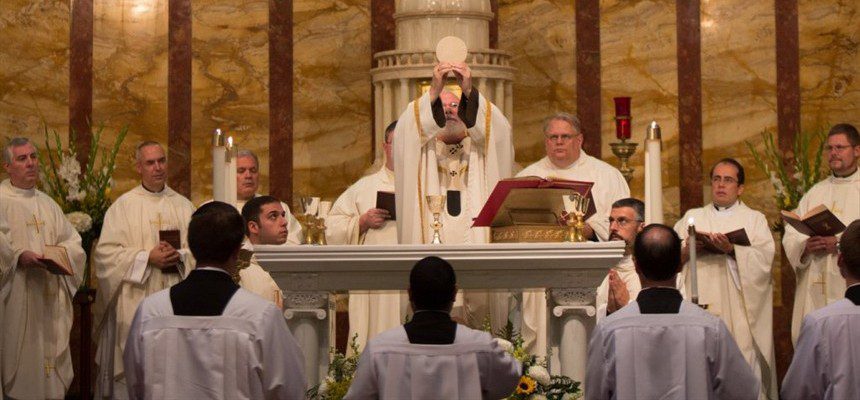
Man Can Be Like Gods
CCC 460, “The Word became flesh to make us “partakers of the divine nature“, For this is why the Word became man, and the Son of God became the Son of man: so that man, by entering into communion with the Word and thus receiving divine sonship, might become a son of God.” “For the Son of God became man so that we might become God.” “The only-begotten Son of God, wanting to make us sharers in his divinity, assumed our nature, so that he, made man, might make men gods.”
Muslims Get to Go Heaven
CCC 841, The Church’s relationship with the Muslims. “The plan of salvation also includes those who acknowledge the Creator, in the first place amongst whom are the Muslims; these profess to hold the faith of Abraham, and together with us they adore the one, merciful God, mankind’s judge on the last day.”
The Catholic Church is the One True Church
CCC 2105 “The duty of offering God genuine worship concerns man both individually and socially. This is ‘the traditional Catholic teaching on the moral duty of individuals and societies toward the true religion and the one Church of Christ.’ By constantly evangelizing men, the Church works toward enabling them ‘to infuse the Christian spirit into the mentality and mores, laws and structures of the communities in which [they] live.’ The social duty of Christians is to respect and awaken in each man the love of the true and the good. It requires them to make known the worship of the one true religion which subsists in the Catholic and apostolic Church. Christians are called to be the light of the world. Thus, the Church shows forth the kingship of Christ over all creation and in particular over human societies.”
Infallibility of the Catholic Church
CCC 2035, “The supreme degree of participation in the authority of Christ is ensured by the charism of infallibility. This infallibility extends as far as does the deposit of divine Revelation; it also extends to all those elements of doctrine, including morals, without which the saving truths of the faith cannot be preserved, explained, or observed.”
Only the Roman Catholic Church has the Authority to Interpret Scripture
CCC 100, “The task of interpreting the Word of God authentically has been entrusted solely to the Magisterium of the Church, that is, to the Pope and to the bishops in communion with him.”
The Pope is the Head of the Church and has the Authority of Christ
CCC 2034, “The Roman Pontiff and the bishops are ‘authentic teachers, that is, teachers endowed with the authority of Christ, who preach the faith to the people entrusted to them, the faith to be believed and put into practice.’ The ordinary and universal Magisterium of the Pope and the bishops in communion with him teach the faithful the truth to believe, the charity to practice, the beatitude to hope for.”
The Roman Catholic Church is Necessary for Salvation
CCC 846, “How are we to understand this affirmation, often repeated by the Church Fathers? Re-formulated positively, it means that all salvation comes from Christ the Head through the Church which is his Body: Basing itself on Scripture and Tradition, the Council teaches that the Church, a pilgrim now on earth, is necessary for salvation: the one Christ is the mediator and the way of salvation; he is present to us in his body which is the Church. He himself explicitly asserted the necessity of faith and Baptism, and thereby affirmed at the same time the necessity of the Church which men enter through Baptism as through a door. Hence, they could not be saved who, knowing that the Catholic Church was founded as necessary by God through Christ, would refuse either to enter it or to remain in it.”
Sacred Tradition: Equal to Scripture
CCC 82, “…the Church, to whom the transmission and interpretation of Revelation are entrusted, does not derive her certainty about all revealed truths from the holy Scriptures alone. Both Scripture and Tradition must be accepted and honored with equal sentiments of devotion and reverence.’”
Forgiveness us of Sins, Salvation, is by Faith and Works
CCC 2036, “The specific precepts of the natural law, because their observance, demanded by the creator, is necessary for salvation.”
CCC 2080, “The Decalogue contains a privileged expression of the natural law. It is made known to us by divine revelation and by human reason.”
CCC 2068, “so that all men may attain salvation through faith, Baptism and the observance of the Commandments,”
The Full Benefit of Salvation is Only Through the Roman Catholic Church
“For it is only through Christ’s Catholic Church, which is “the all-embracing means of salvation,” that they can benefit fully from the means of salvation” (Vatican 2, Decree on Ecumenism, 3).
Grace can be Merited (earned)
CCC 2010, “Moved by the Holy Spirit and by charity, we can then merit for ourselves and for others the graces needed for our sanctification.”
CCC 2027, “Moved by the Holy Spirit, we can merit for ourselves and for others all the graces needed to attain eternal life, as well as necessary temporal goods.”
The Merits of “Mary and the Saints” can be Applied to Roman Catholics and Others
CCC 1477, “This treasury includes as well the prayers and good works of the Blessed Virgin Mary. They are truly immense, unfathomable, and even pristine in their value before God. In the treasury, too, are the prayers and good works of all the saints, all those who have followed in the footsteps of Christ the Lord and by his grace have made their lives holy and carried out the mission in the unity of the Mystical Body.”
Penance is Necessary for Salvation
CCC 980, “This sacrament of Penance is necessary for salvation for those who have fallen after Baptism, just as Baptism is necessary for salvation for those who have not yet been reborn.”
Purgatory
CCC 1031, “The Church gives the name Purgatory to this final purification of the elect, which is entirely different from the punishment of the damned. The Church formulated her doctrine of faith on Purgatory especially at the Councils of Florence and Trent. The tradition of the Church, by reference to certain texts of Scripture, speaks of a cleansing fire:
CCC 1475, “In the communion of saints, “a perennial link of charity exists between the faithful who have already reached their heavenly home, those who are expiating their sins in purgatory and those who are still pilgrims on earth. Between them there is, too, an abundant exchange of all good things.” In this wonderful exchange, the holiness of one profits others, well beyond the harm that the sin of one could cause others. Thus recourse to the communion of saints lets the contrite sinner be more promptly and efficaciously purified of the punishments for sin.
Indulgences
CCC 1471, “The doctrine and practice of indulgences in the Church are closely linked to the effects of the sacrament of Penance. What is an indulgence? ‘An indulgence is a remission before God of the temporal punishment due to sins whose guilt has already been forgiven, which the faithful Christian who is duly disposed gains under certain prescribed conditions through the action of the Church which, as the minister of redemption, dispenses and applies with authority the treasury of the satisfactions of Christ and the saints.’ ‘An indulgence is partial or plenary according as it removes either part or all of the temporal punishment due to sin.’ The faithful can gain indulgences for themselves or apply them to the dead.”
CCC 1478, “An indulgence is obtained through the Church who, by virtue of the power of binding and loosing granted her by Christ Jesus, intervenes in favor of individual Christians and opens for them the treasury of the merits of Christ and the saints to obtain from the Father of mercies the remission of the temporal punishments due for their sins. Thus the Church does not want simply to come to the aid of these Christians, but also to spur them to works of devotion, penance, and charity.
CCC 1498, “Through indulgences the faithful can obtain the remission of temporal punishment resulting from sin for themselves and also for the souls in Purgatory.”
CCC 1472, “…On the other hand every sin, even venial, entails an unhealthy attachment to creatures, which must be purified either here on earth, or after death in the state called Purgatory. This purification frees one from what is called the “temporal punishment” of sin…”
Mary (there are many false doctrines concerning Mary found in Roman Catholicism, here are a few)
Mary is Mediatrix, CCC 969, “Therefore the Blessed Virgin is invoked in the Church under the titles of Advocate, Helper, Benefactress, and Mediatrix.’”
Mary brings us the gifts of eternal salvation, CCC 969, “Taken up to heaven she did not lay aside this saving office but by her manifold intercession continues to bring us the gifts of eternal salvation…”
Mary delivers souls from death, CCC 966, “…You [Mary] conceived the living God and, by your prayers, will deliver our souls from death.”
Prayer to the Saints
CCC 2677, “By asking Mary to pray for us, we acknowledge ourselves to be poor sinners and we address ourselves to the ‘Mother of Mercy,’ the All-Holy One. We give ourselves over to her now, in the Today of our lives. And our trust broadens further, already at the present moment, to surrender ‘the hour of our death’ wholly to her care.”
CCC 1374, “In the most blessed sacrament of the Eucharist “the body and blood, together with the soul and divinity, of our Lord Jesus Christ and, therefore, the whole Christ is truly, really, and substantially contained.”
CCC 1376, “The Council of Trent summarizes the Catholic faith by declaring: “Because Christ our Redeemer said that it was truly his body that he was offering under the species of bread, it has always been the conviction of the Church of God, and this holy Council now declares again, that by the consecration of the bread and wine there takes place a change of the whole substance of the bread into the substance of the body of Christ our Lord and of the whole substance of the wine into the substance of his blood. This change the holy Catholic Church has fittingly and properly called transubstantiation.”
Eternal Condemnation for Anyone Who Believes He Can Know for sure He’s Going to Heaven
The Council of Trent (Canon 16): The Council specifically declares, “If anyone says that he will for certain, with an absolute and infallible certainty, have that great gift of perseverance even to the end, unless he shall have learned this by a special revelation, let him be anathema” (Session VI, Canon 16).