
How Readest Thou? Part 1 How Do We Approach God’s Word? ~Interview with James Fire
The article below is part one of a series exploring both practical and purposeful approaches in studying God’s Word. Recently, Once Lost Ministries reached out to several seasoned believers, asking questions concerning their view and sincere study of Scripture in an effort to further equip and encourage believers from falling for any of the abundant pitfalls plaguing today’s “Christianity”.
“Every word of God is pure: He is a shield unto them that put their trust in Him” Proverbs 30:5
When the lawyer asked Jesus what he had to do to inherit eternal life, Jesus didn’t simply send him back to the Old Testament. Jesus took him deeper. He asked a very serious question with the purpose of exposing the lawyer’s heart. (Luke 10:26)
Jesus not only challenged the lawyer’s direction but also his intention in reading the Bible.
This is often a missing piece when going to Scripture. The Bible isn’t a self-help book! It’s not some sort of mystical methodology! Let us all humbly consider why are we really reading God’s Word.
~Flynn Huseby (Once Lost Ministries)
——————————————————————————————————————–
~The Beauty of God’s Word~ Graciously contributed by James Fire
Question 1: Upon being born again, how did your view of God’s Word change?
As a Roman Catholic, I had a certain religious respect for the Bible, occasionally opened it and read bits and snatches of it, but was never very serious about reading it until my mid-teen years. I always thought of it as a text for life with wisdom and insights to make the quality of life better.
It wasn’t until I gave up trying to find answers in spiritualism, occult practices and other religious systems and returned to the Bible as a last resort that I found the answers I craved. That’s when I was serious about searching it out and that led to my salvation in Christ (after reading through the Gospels, the book of ACTS, then ROMANS up to Ch. 4 – where I found my answers!).
That revolutionized everything in my life, transforming my perspectives on GOD, Jesus Christ, the Bible, Judgment Day and salvation. Once I was born again, I saw the Bible for what it is: the revelation of GOD in His truth and grace. It’s the exclusive and ultimate authority for the Christian and the church.
Question 2: What is the purpose of God’s Word?
We learn about the heart and mind of GOD through the Word, and the central message of the Bible: the LORD Jesus Christ. Through the Word we learn about GOD’s character of holiness and love, how He is to be worshiped, how we as His saints are to govern our lives. It provides for our spiritual nourishment and edification, godly counsel as well as insights into humanity, the angelic realm, the world today, and the world to come. His plan for Israel is throughout the entire text. The Word is a compass to direct our path, and a prophetic clock to let us know the signs of the times.
Additionally, while it’s the exclusive source for our doctrine, it’s more than a mere textbook of and for knowledge. It’s also a love letter written to us consisting of 66 books.
Question 3: What is your personal approach to reading and studying God’s Word?
We approach the Word of GOD in two ways:
Reading for the purpose of soaking in it, meditating on it, finding solace and encouragement in its pages. Reading it as a means to know the heart of our LORD: this is the devotional aspect of how we approach the Scriptures.
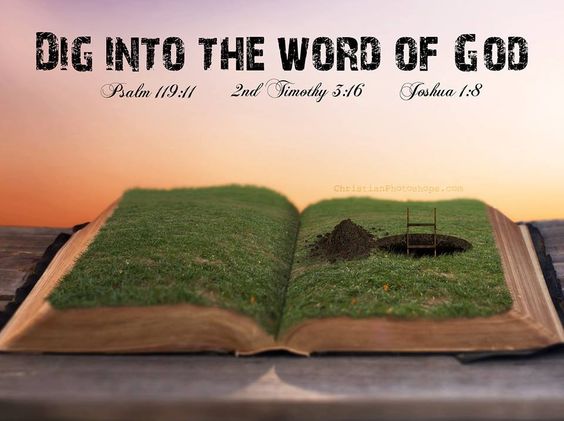
In addition to the devotional aspect, there is the doctrinal aspect. Whereas the devotional can be seen as soaking in a “spiritual hot tub” of sorts, the doctrinal aspect is more like a gold mine. This requires spiritual sweat and effort, working to uncover the treasures contained in it. Both are rewarding, both will yield benefits to the diligently seeking student. Both do us good in our spiritual life.
Our relationship with the Word is like any other relationship. It’s not one dimensional or limited to one specific aspect. Inasmuch as we have different needs and multitudinous deficiencies, the Scriptures provide all that we need.
I have several bookmarks in my Bible, one for each section of the Bible (Torah, OT History, Poetic Books, Prophets – Major and Minor, Gospels, etc.) and I try to read two or three portions per day (This is a rather advanced method of reading that I don’t recommend for anyone except those who are well acquainted with the Bible. Prior to this, I had just two bookmarks, one for the Old Testament, and one for the New Testament).
By having a marker in each section, I can cover more ground quicker, and thereby maintain a broader view of the Scriptures.
Then when it comes to study of the Scriptures, I engage in expositional study, taking one of the sixty-six books and prepare to dive in by reading it through several times (G. Cambell Morgan would read a book fifty times before starting his study!!).
Once I’m satisfied that I’m sufficiently familiar with the book, I will review different outlines in various Study Bibles and select one of those as a preferred method of dividing the book.
Then I’ll go over each chapter and look for subject breaks and parse and group verses that deal with the various subject matter.
Once that’s done, I will begin with prayer (and keep a prayerful attitude throughout my time of study) and start with Chapter 1, vs. 1. I will employ exposition by careful observation of what the verses actually say. I will look up key phrases and words in Hebrew and Greek (which may result in some word studies), look at different cross-references (those listed in my Study Bible, and those of my own scribbled notes).
Within the text of Scripture, I may divert on a topical study where appropriate (for example, in JOHN 10, the LORD Jesus refers to Himself as the Good Shepherd, so I may do a brief topical study on “shepherds”).
Where there are prominent persons mentioned, I might be led of the Spirit to do a character study.
I will also give a subject title for each section of Scripture that I’ve parsed (that may or may not appear in the final study). I might construct charts, lists, word comparison diagrams to help organize biblical themes or doctrines covered.
Once I have gleaned all that I can by careful observation of the text, I’ll move on to interpretation, going from “What does it say?” to “What does it mean?” More cross-references will be employed here, and prayers continue.
Then I will seek the LORD on proper application based on my observation and interpretation. It’s about then that I might consult some commentaries and compare – taking nuggets of truth from them that I might have overlooked in my exposition. If this is a teaching for church, I’ll try to find an appropriate title (or even if it ends up as an article for my website).
Question 4: What is some beneficial advice gleaned from other for reading and studying the Scriptures?
From a course I took in Bible College I was taught about commentaries: “glean, don’t lean on them”. The Holy Spirit wants to teach me His Truth directly, making my study time intimate and edifying. We don’t require a “filter” of commentaries to learn the Bible. Commentaries can serve us with difficult passages encountered, as guard rails to make sure we don’t go off, and for general reinforcement of what the LORD reveals to us.
In close proximity to this, from Josh McDowell I learned to trust the leading of the Spirit in study of the Scripture. While a certain method in the study of the Word is helpful (listing of key words, charts, diagrams, timetables, studies in Hebrew and Greek), don’t be dependent on structure. “Follow the Spirit’s leading and go where He goes, and you’ll always be in for an adventure!”
From Chuck Missler I learned (A LOT!) – that nothing is incidental in the Scriptures. That the Bible is in fact an “integrated message system” that is self-contained, self-interpreting, and self-explanatory (in conjunction with the Holy Spirit). Idioms, place names, names of people, and the overall structure of Scripture are all there by design and uncovering these expresses its Divine authorship.
From Chuck Smith I learned that a steady diet of the Bible from cover to cover and once completed, return and repeat is the safest method to ensure doctrinal balance, spiritual stability and a fulfilling and prosperous walk. Or as I recently stated, “GOD don’t waste no ink! If He bothered to inspire His writers to pen the book of Obadiah and Songs of Solomon, then He intends for us to read, study and learn from even the most unread books that are seldom touched.”
From David Wilkerson I learned that we must make the Word of GOD our passion and cultivate a healthy appetite for it – it doesn’t grow by itself and the flesh will always resist our devotion to this Holy Book. That the Bible and prayer must go hand in hand: never dive into one without the other. I like to compare this with a rowboat. One oar in the water only get you going in circles. Both oars will set you off in a sure direction. So also with the Word and prayer.
From Dave Hunt I learned that we live in a world of lies and deceptions where the enemy wants to steal our spiritual foundation of truth, and as disciples of the Word, we must be diligent in searching the Scriptures daily to see if [anything is true or not]”. Discernment is a gift of the Spirit that grows as we cultivate it by a careful study of the Word.
Question 5: Do you have any recommended study helps and resources?
I have frequently stated that were I on a deserted island and I could only bring two books with me, they would be my Thompson Chain Reference Bible and an exhaustive Strong’s Concordance. With the Hebrew and Greek Lexicons and other tools contained therein, along with my study Bible, were you to leave me alone on that island for a year, upon your return I would have the equivalent knowledge of a Bible Scholar (or close enough so that the difference wouldn’t matter!)
Thanks to online resources that we have at our fingertips, we have a plethora of helps that can enhance our study of GOD’s Word. The Blue Letter Bible is a powerhouse of information, and it’s FREE!
I have also found the expositional studies on the books of the Bible by Chuck Smith, Chuck Missler and Dave Hunt with T.A. McMahon most helpful, tipping me off to nuggets that could’ve taken me a long time to dig out!
Question 6: What are a few favorite Bible verses regarding God’s Word and our approach to reading Scripture?
PSALM 119:10-12
“With my whole heart I have sought You; Oh, let me not wander from Your commandments! 11 Your word I have hidden in my heart, That I might not sin against You! 12 Blessed are You, O LORD! Teach me Your statutes!”
ISAIAH 66:1-2
“Thus says the LORD: “Heaven is My throne, And earth is My footstool. Where is the house that you will build Me? And where is the place of My rest? 2 For all those things My hand has made, And all those things exist,” Says the LORD. “But on this one will I look: On him who is poor and of a contrite spirit, And who trembles at My word.”
1 THESSALONIANS 2:13
“For this reason we also thank God without ceasing, because when you received the word of God which you heard from us, you welcomed it not as the word of men, but as it is in truth, the word of God, which also effectively works in you who believe.”
PHILIPPIANS 1:6
“Being confident of this very thing, that He who has begun a good work in you will complete it until the day of Jesus Christ.”
—————————————————————————————–
James Joseph Fire Bio (The Truth Under Fire- www.thetruthunderfire.com)
Apologetics, Prophecy, Bible Teacher
James Fire was born in Syracuse, NY to an average Roman Catholic Italian family of five. He faced a lot of physical struggles with deformities and poor health for much of his childhood. Being a weakling and ‘different looking’ he was often the object of ridicule and bullying. Having barely escaped death twice before he was 10 years old, his mother told him, “God has you alive for a PURPOSE!” He was very religious and felt a closeness or a yearning to be close to God, but went astray in his search for spiritual reality by exploring and practicing the occult – and used his ability to fight back against the bullies.
Eventually he left the occult and pursued the Bible in a last desperate attempt to find his “purpose” and on June 20, 1980, in the privacy of his bedroom, he accepted Jesus Christ as LORD and Savior and was born again (To read his testimony go to this link Can I Get A Witness on FROM the MIND of FIRE).
In OCT of 1993 he, along with two friends after much prayer, moved from New York to Arizona, where he lives today, ministering to the saints in church with sermons, Bible teaching, and Discipleship classes. He writes for the website The TRUTH Under FIRE and two blogs (links for these found on TTUF): FROM the MIND of FIRE and The RED PILL Consortium.
James Joseph Fire
Bible Teacher, Apologist,
Founder of The Truth Under Fire